Lately, I’ve been deep in The Midnight Library by Matt Haig. I have no idea why it took me so long to read it.
It follows Nora, who finds herself in a library between life and death, with the opportunity to experience the lives she might have lived had she made different choices.
It’s made me think a lot about some of my own parallel lives. For instance, I knew I was called to lead Kirtan in 2014 right when I first discovered it. And yet - it somehow took me eleven years to finally begin.
So when I think about parallel lives, sometimes the questions I ask are…
What would have happened if I bought a harmonium in 2014, right when I first discovered the Kirtan practice? What if I’d gone back to Mexico for my 300-hour YTT in 2015, instead of doing a different student teaching placement, and was submerged in kirtan again? What would have happened if I started taking harmonium lessons in Abu Dhabi in 2019 when I first bought my harmonium when I first got sober? Or in 2021, if I started learning how to lead kirtans right when I moved to Bali?
I have shared often with people that I have regrets. Part of me wishes I hadn’t waited eleven years to lead kirtan, because right when I finally started to lead it - after doubting myself and waiting eleven years - this practice cracked the door open to the inner temple, and changed my life.
So yes, a big part of me regrets that I waited so long - and wonders how my life would be different if I started playing harmonium and leading kirtans eleven years ago, in 2014, instead of 2025. And yet, I know that I can’t keep thinking about my regrets - because I’m here now - finally playing harmonium and leading kirtans - and I get to share it with all of you.
I often tell my students that my hope for them is that they don’t wait eleven years to do something they feel called towards. I hope that they don’t have eleven years of regrets, like I did. So if you’ve fallen in love with kirtan, too, my hope is that you give yourself the chance to begin, or explore, now. You don’t need to wait until you feel completely ready! (I didn’t feel completely ready the first time I played a gig. I actually was utterly terrified.)
(By the way, are you reading this and wondering whats a kirtan? It’s a call and response musical meditation. Here’s a livestream of one I led last week in Ubud).
I created my 100 Hour How to Lead a Kirtan training, because it’s the training I wish that I had eleven years ago to get me started. This idea was percolating in my head for a long time, but something about the way I work is that sometimes I can feel stuck for a long, long time. I have an idea but no momentum. I get annoyed with myself. I wonder whether I’ll ever finish a project.
And then, it suddenly clicks. And when it clicks, it FLOWS.
That’s what has happened with my How to Lead a Kirtan Training manual.
After feeling stuck on it for ages, I’ve spent the last stretch bringing everything together. Tonight, I finished the main content for the manual - about 100 pages of philosophy, stories, mantras, harmonium lessons, and practical guidance for leading.
I am SO excited.
As I listen to the music and prepare these lessons, I keep imagining us together in my shala. Learning a chord. Singing a phrase again. Laughing when our hands and voices won’t cooperate. Having another go.
And gradually building the confidence to lead.
What we’ll be doing together
On Sunday, January 31st, 2027, my first How to Lead a Kirtan Beginners Bhakti Training will begin. We’ll begin on Sunday with a welcome circle, an arrival kirtan, and dinner prepared by our team.
Then we have eight full days of learning and practice together from Feb 1 - 10, (except for one day off, to explore Ubud, on Sunday!)
Each day will centre on a deity and a simple chant. We’ll meet Ganesha, Krishna, Shiva, Hanuman, Ram and Sita, Durga, Lakshmi, and Saraswati through yoga, traditional stories, philosophy, and music.
We’ll learn where the stories come from and what the words we’re singing mean. There will be space to ask questions and reflect on how devotion can become part of everyday life.
Our days will follow this rhythm:
9:30–11:00am: A yoga class themed around the deity of the day, including our chosen chant.
11:00am–12:15pm: Philosophy, traditional stories, and discussion.
12:30pm: Lunch together.
1:30–2:45pm: Afternoon learning and harmonium practice, vocal lessons, etc.
3:00–4:15pm: A second afternoon session to develop and integrate what we’re learning.
4:30-6:00pm: Kirtan, or practice time, or a trip into town to experience a community kirtan!
We’ll spend time getting our hands on the harmonium and exploring our voices. We’ll begin with the basics: finding the keys, operating the bellows, making a steady sound, and learning simple chords. Then we’ll practise moving between chords while singing, following a melody, keeping rhythm, and supporting call and response.
You’ll have clear keyboard diagrams in your manual showing which notes to press, alongside the chants and chord sequences, so you have something practical to return to after the training.
Learning with my teachers
My teacher Diana, who taught me to play harmonium, will be joining us to teach harmonium skills and vocal activation.
With her, we’ll explore how chords work, inversions, and smoother transitions. We’ll practise finding a melody on the harmonium to support accurate singing, and learn about transposing chords, keeping rhythm, and creating a smooth bellows pattern.
We’ll work with chants including a simple Ganesha mantra and a Maha Mantra melody.
There will also be dedicated time to explore and become more comfortable with your voice.
Vasudev, my teacher who leads kirtans here in Bali, will guide sessions on facilitating kirtan.
We’ll explore how to introduce a chant, teach a response, give clear cues, listen to the room, and bring the music to a close. We’ll also look at shaping a whole gathering: choosing chants, working with musicians, allowing silence, and adapting when things unfold differently from what you planned.
These are the things I wanted help with when I was beginning.
We’ll experience kirtan together, too
Alongside the classes, we’ll gather for kirtans throughout the training.
Diana and Vasudev will each guest lead. I’ll lead some evenings with friends singing and playing alongside me. We’ll also take a field trip to Vasudev’s kirtan in town.
You’ll get to experience different ways of leading and notice what helps you feel comfortable joining in.
And you’ll have opportunities to practice yourself.
We’ll build up gradually: a phrase, a response, a short chant, and then a short, co-led kirtan. There will be time for feedback, questions, and another try.
By the end, you’ll have practised leading your own 60-minute kirtan and have a foundation to keep developing at home.
We will close together on the morning of the 10th with one last yoga practice, and a graduation ceremony.
The training I wish I’d had
I know how much courage it can take to let people hear your voice.
To sit behind the harmonium. To sing the first line. To trust that someone will sing back.
That’s why I want us to have time together - to learn, repeat, ask for help, and become more familiar with something that might feel intimidating at first.
This is the training I wish I’d had eleven years ago.
There are only three spots left, and we would love you to join us.
If you’ve been wanting to learn, I hope this can be your invitation to begin.
I’m already imagining us there.
I can’t wait to share it with you.
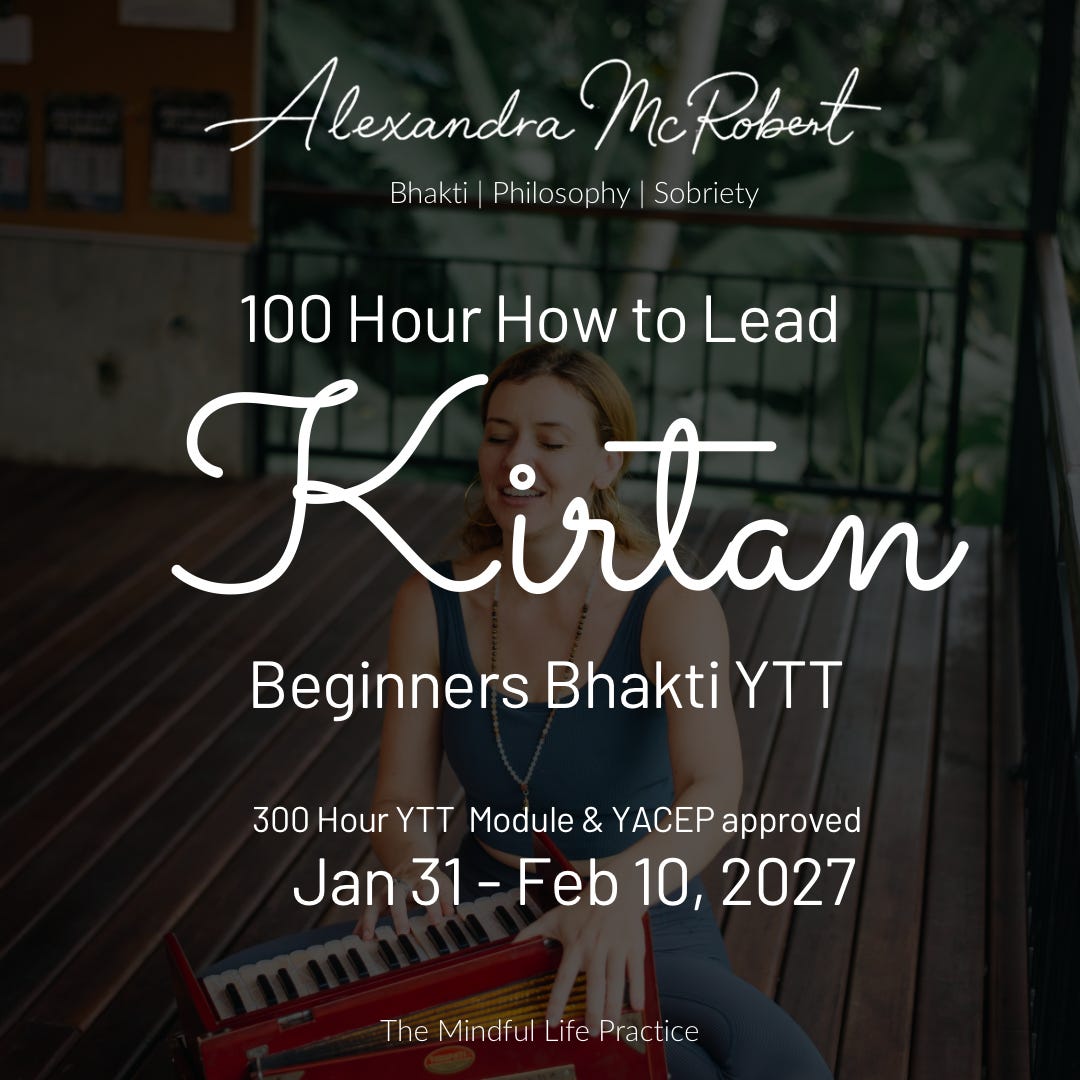
P.S. Not ready to lead at all? I still have spots on my India meditation, philosophy and bhakti retreat where you will get to join us at the Kirtan Festival in Rishikesh. if that feels like more your speed check it out here.