

Step Eleven of the Twelve Steps invites us to deepen our conscious contact with God, as we understand God, through prayer and meditation.
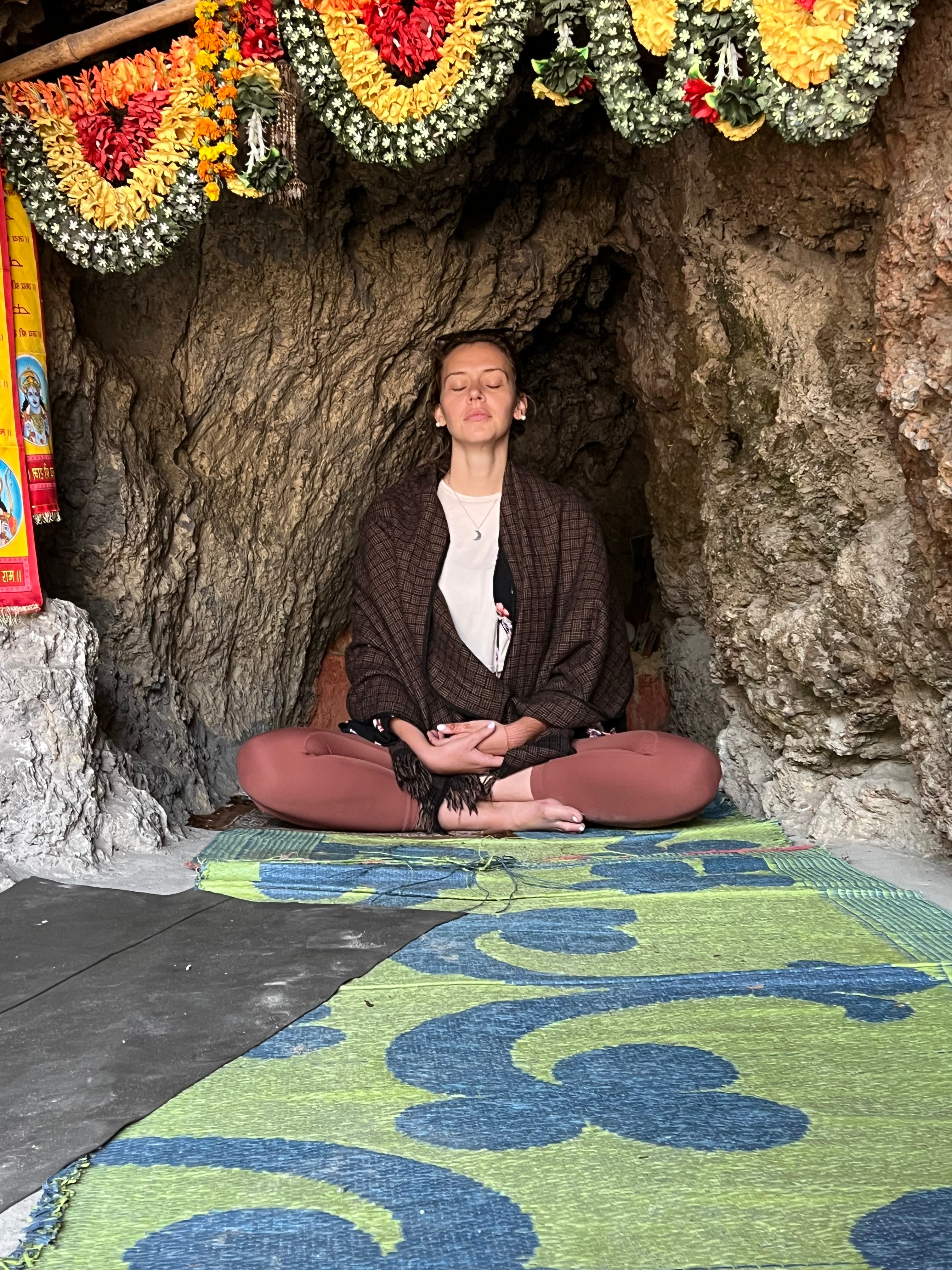
I’ve heard it said that a deep longing lurks at the bottom of the bottle. I recognize that in my own addictive patterns: the reaching for something outside myself, hoping it will change how I feel inside.
It’s evolved so much from alcohol over the years: to coffee, to food, to instagram. But for me, those are often the times when I’ve lost conscious contact with God.
It occurred to me the other day that, over the last year or so, much of my life has unintentionally become devoted to Step Eleven. Kirtan to me is a prayer. I do two twenty minute meditation practices each day. These practices have become the centre of the day. I’ve learned that without them, things are just…pretty crappy. Not only are these practices the center of the day for me…but increasingly, the centre of what I want to teach.
I still identify as a yoga teacher. But when so many people understand yoga primarily as asana - the poses - I sometimes feel that what I practice and teach needs a little more explanation.
I still practice and teach the poses. I value them. But in my own practice, they are also preparation: a way of moving and breathing that helps me become available to sitting, singing and listening. Or: Quieting the mind. Opening the heart.
One of my favourite Ram Dass meditations has these words. He says,
The real work you have to do
Is in the privacy of your own heart
All of the external forms are lovely
But the real work
Is your inner connection
If you're quiet when you meditate
If you truly open your heart
Just quiet your mind
Open your heart
Quite the mind, open the heart
How do you quiet the mind? You meditate
How do you open the heart?
You start to love that which you can love
And just keep expanding it….
Yoga was never meant to be about the poses. In Patanjali’s eight limbs of yoga, poses sit within a much wider practice that includes ethical living, breath, concentration and meditation. There is also ishvara pranidhana, often translated as surrender or devotion to a higher power, the divine, or universal conciousness.
I see the connection with the Twelve Steps. In How it Works, Bill Wilson writes:
”Many of us exclaimed, "What an order! I can't go through with it." Do not be discouraged. No one among us has been able to maintain anything like perfect adherence to these principles. We are not saints. The point is, that we are willing to grow along spiritual lines. The principles we have set down are guides to progress. We claim spiritual progress rather than spiritual perfection.”
Kirtan is where developing my relationship with a higher power becomes most tangible for me. As a practice of devotion, it gives my longing somewhere to go. Through singing, I can transmute what I am carrying: grief into gratitude, restlessness into love. I don’t have to arrive feeling peaceful. I can begin as I am.
Buddhist teachings offer another way of understanding the reaching I recognize in myself. The buddha said how craving can keep us caught in suffering: wanting to hold on to what feels good, push away what hurts, or become something other than what we are in this moment. Meditation offers a way to meet the moment and become curious about that moment.
Can I feel an urge without immediately following it? Can I notice discomfort without rushing to escape it? Can I meet this moment with a little more kindness? To me, it feels like the same: learning to recognize the habits that keep me caught, and cultivating the attention and compassion to respond differently.
When I teach meditation, I often describe a shift between thinking and being. The thoughts don’t have to stop, we just need to notice when we are absorbed in them, and gently return to the felt experience of being here: this body, this breath, this moment. Sometimes the mind becomes quiet. Sometimes I simply become more aware of how busy it is for twenty minutes, and that’s ok. Both are valuable practice.
Over these last few weeks, I’ve spent more and more times with the Buddhist Monks at Bali Meditation Centre, and I feel my meditation practice has strengthened, and I feel grateful for that. I feel like I’m listening to God again when I sit down and get still. I am also reminded that Step Eleven reaches beyond the time spent sitting or praying. In another one of my favourite meditations, Tabula Rasa, Lorraine Weiss says:
“Where your life is your meditation
No separation
Now, the more you spend in that state as really open-hearted, oneness, connection
The more it becomes what you live about
And you start to - it is a rewiring
Your whole nervous system starts to rewire to that state of expansion and peace and connection”
What happens after my meditation? That’s where we see the real fruits of our practice. The Twelve Steps, yoga philosophy and Buddhism each place practice within a wider way of living. We want the quiet we cultivate, and the love we sing about, to become more available in our daily lives, in the way we move through the world, in the way we show up for others, in the way we show up for ourselves.
Maybe this is what conscious contact is coming to mean for me: a relationship I tend through daily practice, and learn to carry into the rest of my day.
As I continue these practices of prayer and meditation, I want to invite you to join me.
ONLINE:
Two new online offerings starting next week
Tuesdays Resting & Flowing With the Sutras at 2pm AWST: Friends in Europe and Middle East who want to flow with me! I finally have something for you! Come join me for a four-week asana class exploring Yoga Sutras 1.1-1.4. I am offering this on Tuesdays at 2:00pm AWST starting in November.
Fridays Sober/Sober Curious Women’s Kirtan & Circle at 8:15am AWST: Friends who want to chant! I am offering a three part kirtan series for sober/sober curious women. We will chant together to the three goddesses Durga, Lakshmi and Saraswati, and gather in community to share. This will be on Fridays 8:15am AWST starting in November for three weeks.
ONLINE 1:1
Bhakti: harmonium and bhakti lessons
Philosophy: one-on-one Yoga Sutra studies
In-person gatherings
Jan 31 - Feb 10, How to Lead Kirtan Training — early bird ends October 31!
Feb 21 - 27, India Bhakti Retreat - SOLD OUT
Feb 27 - March 5, India Immersion in Philosophy and Meditation - Earlybird ends October 31
Study to become a yoga teacher
May 16 - 26, Hybrid 200-hour YTT - ten days in Bali (online before)
Sept 5 - 15, Hybrid 200-hour YTT - ten days in Bali (online before)
Lots of love,
Alexandra