#220 Day One Again
Narcotics Anonymous versus Alcoholics Anonymous & The Many Gifts of Recovery
I am visiting Seminyak this weekend for the Narcotics Anonymous convention. I don’t attend a lot of NA, mostly because I misunderstood it at first. I didn’t really understand how NA was different from AA, or why it was being recommended to me.
When I got into the rooms of AA 1.5 years ago, something that stood out to me was the fact that it was mentioned that we should only have a singularity of focus in those meetings: alcohol. This was hard for me. At seven years sober from alcohol, I no longer really needed to make this my focus. However, I knew that I was suffering and in pain and needed support. I was addicted to Instagram, and I needed help stopping. For me, it’s a dopamine addiction, not an addiction to alcohol specifically.
When I spoke about this after a meeting, someone suggested that I go to the rooms of Narcotics Anonymous. They said that addiction transference was often more openly discussed there.
The first NA meeting I ever attended terrified me. The people had very extreme stories - homelessness, jails, institutions - things that I hadn’t experienced in my addiction (thank God). Because I couldn’t relate to those extremes, I stopped going to meetings and stayed in the world of AA.
This last year, though, I found myself returning to NA, and the way I got there was kind of random. I started chairing the ITAA meeting up in Ubud (Internet and Tech Addicts Anonymous). Because we don’t have our own literature, we started working with the literature of Narcotics Anonymous. To my surprise, I found that I actually loved the NA literature - perhaps even more than the AA literature. That slowly led me back into NA meetings again.
What I didn’t realize was that the difference between AA and NA isn’t just about substances. It’s also about history.
AA is the mothership of recovery programs. Founded in 1935, it is now more than ninety years old. Every twelve-step fellowship that came after it, including NA, owes something to the path AA carved. Because of that history, AA almost feels obligated to preserve its original language and culture. As a result, you encounter things that can feel dated today. You encounter patriarchal language. You encounter ideas and assumptions that were common in the 1930s but feel out of place in modern conversations around identity, inclusion, and recovery.
NA, by comparison, feels like a younger sibling. Although its roots go back to the 1950s, it really came into its own in the late 1970s and early 1980s when it developed its own literature and identity. Some of the cultural differences seem almost intentionally designed to broaden the conversation around addiction. The emphasis is on addiction itself rather than any particular substance. The language of “Higher Power” often feels more central than the language of God. There is a strong emphasis on welcoming people regardless of race, sexuality, gender, religion, or the particular form their addiction takes.
One thing I learned recently is that NA’s First Step doesn’t actually mention drugs. It says: “We admitted that we were powerless over our addiction, that our lives had become unmanageable.” That choice was intentional. AA’s First Step names alcohol specifically. NA deliberately widened the lens, making the fellowship about addiction itself rather than any one substance. As someone who struggles more with Instagram than alcohol these days, that distinction suddenly feels very important.
As a result, I find that I can sit in an NA meeting and be much more aware that whilst I say I am seven years sober, it’s not actually true. I am sober from alcohol, but I am not sober from Instagram.
I know I get dopamine hits from posting on my stories for validation, from checking responses, from seeing who has viewed them, from watching likes accumulate. I know the compulsive urge to check even when there is nothing important waiting for me. When addiction becomes universalized, I can no longer hide behind the fact that my substance isn’t alcohol. I can’t intellectualize my way around it or pretend it’s somehow different.
I was at the convention for less than an hour yesterday before I realized that yesterday would be Day One again of getting off Instagram. June 12. My brain immediately started swelling in my withdrawal. Every time I detox from Instagram, I notice it physically. My brain feels swollen. My thoughts become louder. There is a restlessness that appears, almost as though my nervous system is demanding its usual hit. The difference now is that I recognize what is happening. The withdrawal isn’t so intense because I have experienced it so many times before.
Something interesting happened this weekend, though, that I wasn’t expecting - that prompted me into getting off Instagram again.
I originally came down here for a fairly superficial reason. There was a guy at the meetings for the last few months who kept promoting the convention merchandise, and I thought it looked nice. I wanted to support the event. I had no idea how much I would end up relating to what I heard here.
Last night, the opening speaker was someone I recognized. At first, I couldn’t place him. Then I slowly realized that he had chaired the very first NA meeting I attended 1.5 years ago.
I remember him speaking about cleaning out the home of someone who had died from addiction. Even though the person was a billionaire, there were piles of unopened bills sitting on the table. I remember hearing that story and feeling an immediate sense of identification. When I first got serious about recovering from Instagram addiction, one of the first things I had to do was clean up my finances. I had multiple businesses, unpaid fees, accounts scattered across countries, and administrative chaos everywhere. The details were different, but the energy underneath it felt remarkably similar. I spent two months of Instagram sobriety reorganizing my life. I remember saying to someone, “it’s like I’m in addiction recovery again.” (Not realizing that I actually was, lol).
At the end of last night’s meeting, someone came up and reintroduced himself to me. We had also met at that same first NA meeting 1.5 years ago.
I remembered him because he used language that I had already decided was cultish.
“You have to connect with other female addicts. Easy Does It. One Day at a Time. Just for Today.”
I remember rolling my eyes a little.
I also remembered that he had texted me from Australia to check in on me after I missed my first morning meeting in six weeks. I remember wondering how he had even knew I wasn’t there (was he a psychic?). What I didn’t know at the time was that I had been drugged and sexually assaulted the night before. I was still high. Still in shock. Still unaware of what had happened to me.
Last night, he asked me how the last year and a half had been.
I found myself almost speechless. How do I summarize this period of my life in a few minutes after a meeting?
I experienced a life-changing trauma. I hit bottom. I built a yoga studio. I transformed my life. I came out as a lesbian.
Overall, the changes have been beautiful. But they have also been hard.
So I just said, “things with me are good!”
There’s also a woman I keep seeing from afar at both the AA and NA conventions who was there that first meeting of mine a year an a half ago, too. We had a conversation back then that I still think about.
At the time, I was deep in the shame story around my divorce. I said to her, “I really fucked up his life.”
She replied, “But did you fuck up his life? Or did you fuck up a moment in his life?”
I think about that more and more these days.
She helped me see how I’d built a whole identity around one moment from my life.
For years, my identity was organized around what happened in Kuwait. Then my identity became organized around the assault. Now I barely think about Kuwait or the assault anymore. The person in those stories feels like a character from another story, another book. The story I am living now is about becoming queer, integrating that identity, and beginning to date women.
That’s the story now.
One of the things recovery continues to teach me is that our lives keep changing, even when we are convinced that a particular pain or event will define us forever. The stories that feel all-consuming eventually become chapters. Last night’s speaker said, “Sometimes I feel like I’m living in a sitcom and it’s like season ten episode nine.” I was laughing in stitches at that!
Sometimes people question my Instagram addiction. This weekend I was with an old friend and he said to me, “You don’t really have an addiction… you haven’t looked at your phone once since we’ve been together all afternoon.”
He’s right, but that’s not how it works for me. I don’t reach for Instagram when I’m deeply connected to another human being. I reach for it when I’m alone. I’m not addicted to posting. I’m addicted to checking. I’m addicted to seeing who followed me, who viewed my stories, who liked my content. I’m addicted to the tiny hit of validation that tells me I belong.
As my brain continues to detox from Instagram, I hope I can stay close to my Higher Power and remember what recovery has already taught me. The substance is rarely the point. The craving is.
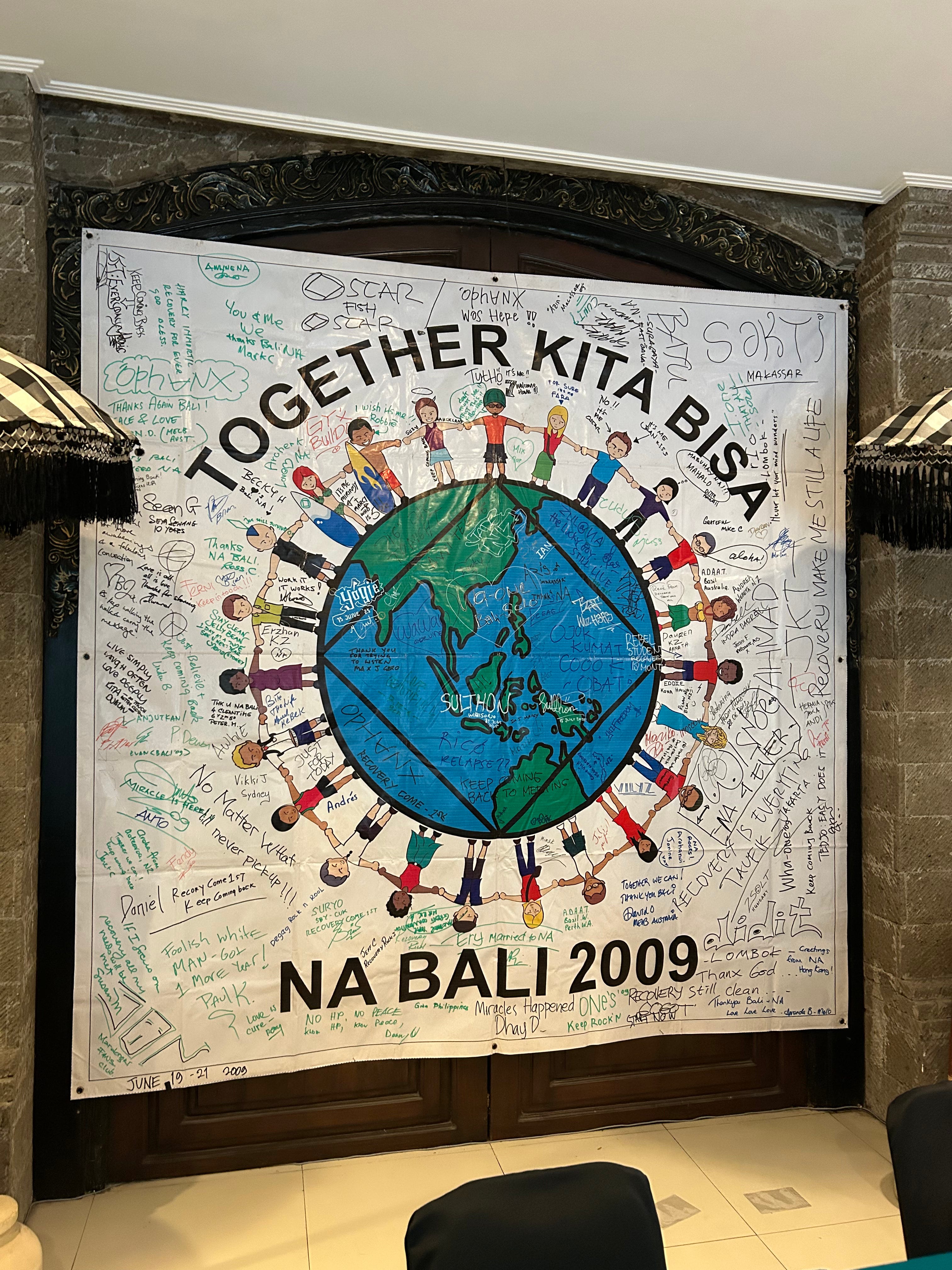
One thing that has deeply touched me about this convention is how intentionally Indonesian people have been included in the planning and execution of the event. There is a live teleprompter translating everything into Bahasa Indonesia. That is surprisingly rare in Bali. Around the room are banners from previous conventions stretching back decades. Every theme is half written in Bahasa, half in English. Looking at them, you can see the history of this recovery community unfolding year after year.
This year’s theme is:
Satu Janji, Many Gifts.
One Promise, Many Gifts.
The promise is simple: if I stay out of active addiction, I will receive gifts from recovery.
Just for today.
Next Online Program Starts June 25 - Resting with the Sutras!
We take a week off online yoga classes as the next yoga teacher training starts tomorrow in Bali!! My next online program, Resting with the Sutras, is starting June 25.
What We'll Explore:
Weeks 1–2: Vairāgya: The Practice of Letting Go
Sutras 1.15–1.16
We begin with Patanjali’s teachings on non-attachment. These weeks practices will invite inquiry around: attachment, identity, addiction and compulsion, longing and control, and witnessing rather than reacting.
Weeks 3–4: Samadhi
Sutras 1.17–1.18 What happens when the mind becomes quiet? Patanjali describes stages of meditative absorption, from concentration and inquiry to bliss and stillness beyond thought. During the classes, themes will revolve around: meditation and concentration, subtle awareness, bliss and spaciousness, the inner journey of yoga.
Weeks 5–8: Faith, Practice & Spiritual Momentum
Sutras 1.19–1.22 These sutras remind us that awakening unfolds through faith, courage, remembrance, focused practice and wisdom. We explore how consistent practice and how intensity, sincerity and devotion influence our path.
Weeks 9–12: Īśvara, Devotion & Om
Sutras 1.23–1.27 After discipline and meditation, Patanjali offers another doorway: surrender. These weeks explore: Īśvara Praṇidhāna,the guru principle, divine consciousness, Bhakti and devotion, mantra as meditation, Om as sacred sound, and refuge.


All of us have a journey and we all experience highs and lows. Than you for your wisdom guiding all of us, including yourself 🙏