#210 On Releasing Resentments (and how the rooms of AA are practicing, with sincerity, the teachings of yoga)
Asmita, the kleśas, and the path out of suffering through AA, Buddhism, and the Yoga Sutras
I joined the 12-step recovery rooms a few months before I hit six years sober. That was in January 2025.
For the first five years of my sobriety, I had been part of a community of women who were anti-AA: the newer, modern recovery spaces. And I still resonate with a lot of that world. But the truth is, I judged AA before I knew anything about it.
At the time, I didn’t want to use the word alcoholic. That was the main thing.
Then I read a well-known book in the sober women’s space that argued AA was designed for men. The author said that women don’t need to apologize, because we’ve been apologizing all our lives. That we don’t need to examine our character defects, because we’ve already been overanalyzing ourselves for years.
I read this and felt validated in my belief that AA wasn’t for me. I felt that it didn’t align with my values, that it wasn’t feminist.
And yes, there are still aspects of the twelve-step program I don’t fully agree with. I don’t love the term character defects. I would probably call them areas of growth.
But the truth is, after a year and a half of going to meetings, I am much happier than I was before.
At times in my life, I’ve fallen into a victim mentality, personalizing everything that has happened to me. (You can hear more about it in my book Sober Yoga Girl.)
I sometimes call it main character syndrome: the belief that everything is happening to me.
In yoga philosophy, this connects directly to one of the kleśas, the root causes of suffering. In Patanjali’s Yoga Sutras it is called asmita, or ego.
Asmita is the misidentification of the self. It’s when we become so identified with our thoughts, our story, our identity, that we believe everything revolves around us. We take things personally. We center ourselves in every narrative. We believe: this is happening to me, because of me, about me.
And from that place, suffering multiplies.
Because the truth is, most of the time, people are not thinking about us nearly as much as we think they are. They are living in their own minds, their own wounds, their own stories.
When I’m in asmita, everything feels personal.
When I step out of it, I can see reality more clearly.
Patañjali describes five kleśas:
Avidyā (ignorance)
Asmita (ego)
Rāga (attachment)
Dveṣa (aversion)
Abhiniveśa (fear of loss of life as we know it)
I teach about this in my yoga sutra study. We started the course last week but you could still join us here!
And when I look at my life through this lens, it becomes clear:
My resentments are dveṣa (aversion).
My tendency to stay in unhealthy relationships are rāga (attachment).
The tendecy to believe everything is about me is asmita.
What I learn from being in the rooms of AA is something different.
I am learning to reduce my suffering by looking at my own participation in it.
By asking:
What choices did I make? Where did I ignore myself? Where did I stay when I should have left?
This doesn’t mean I take responsibility for other people’s actions.
It means I take responsibility for my own.
All my life, I participated in my own suffering by staying: in relationships, friendships, work environments, where something didn’t feel right. Where my intuition was saying, this isn’t for you.
And I ignored it.
That is where my work is now: learning to trust that voice, and to remove myself when something feels off. That’s been the work of my life for the last year or so!
This is one of the reasons I’ve come to love the twelve-step rooms.
Because the process of making amends and identifying our “defects” isn’t really about shame, it’s about awareness.
It’s about asking:
Where have I been selfish?
Where have I judged others?
Where have I been unkind?
Where have I ignored my intuition and ended up in pain later?
We are not here to take other people’s inventory. We’re not pointing fingers and blaming others. We’re taking our own inventory and seeing how our behaviour shift.
This is also aligned with the teachings of Buddhism.
I am currently reading The Heart of the Buddha’s Teaching by Thicht Naht Hanh, to prepare for the Buddha Dharma studies course that I am teaching starting April 28 on Zoom. There’s a powerful metaphor: every time we ruminate on the past, it’s like stabbing ourselves again and again. The original wound may have happened once, but our mind keeps recreating the suffering. Our suffering is not just caused by what happens to us, but by what we continue to feed.
The Buddha invites us to ask: What am I consuming that is sustaining my suffering?
Our thoughts, our conversations, our environments, even what we scroll.
When we see clearly what we are feeding, we can begin to choose differently.
Patañjali says something almost identical in Yoga Sutra 2.16:
Heyam duḥkham anāgatam
Future suffering can be avoided.
This is our practice. Preventing future suffering through awareness.
And one of the most practical tools for this is Yoga Sutra 1.33:
By cultivating friendliness toward the happy, compassion toward the suffering, joy toward the virtuous, and equanimity toward the non-virtuous, the mind becomes clear.
If you want to go deeper into this teaching, I actually taught a full yin class on this sutra which you can practice on YouTube for free here!
In AA, I see this sutra lived out in real time.
People practicing compassion instead of resentment. Tolerance instead of judgment. Humility instead of blame.
It’s a practice. Like for everyone, it’s not something that comes naturally. We just keep practicing it until it sticks.
Recently, I’ve also been reflecting on how social media keeps us connected in ways that weren’t possible before.
Historically, people would leave our lives, and that would be it. Maybe we’d think of them occasionally, but we would move on.
Now, everyone remains visible.
And when I scroll, old resentments can resurface.
I remember things people said. Things they didn’t say. Ways I felt hurt or unsupported.
I even think back to things I used to post:
“What not to say to your sober friend…”
“How to not support someone with mental health…”
So much of it was rooted in resentment. In wanting others to behave differently so I wouldn’t feel hurt.
Now I see it differently. It’s not about controlling how others show up. It’s about protecting my vulnerability, and choosing where I place it. Because those patterns were keeping me sick. Resentments were keeping me sick. Now, I’ve limited so much of even the stories I share on my Substack, for this reason. It’s not about me not wanting to share - it’s about protecting my wellbeing, protecting my peace, and keeping my stories for the people and places that can hold them.
In the AA rooms, I hear people speak about letting go of resentments. About praying for others when they are irritated by them. About choosing compassion.
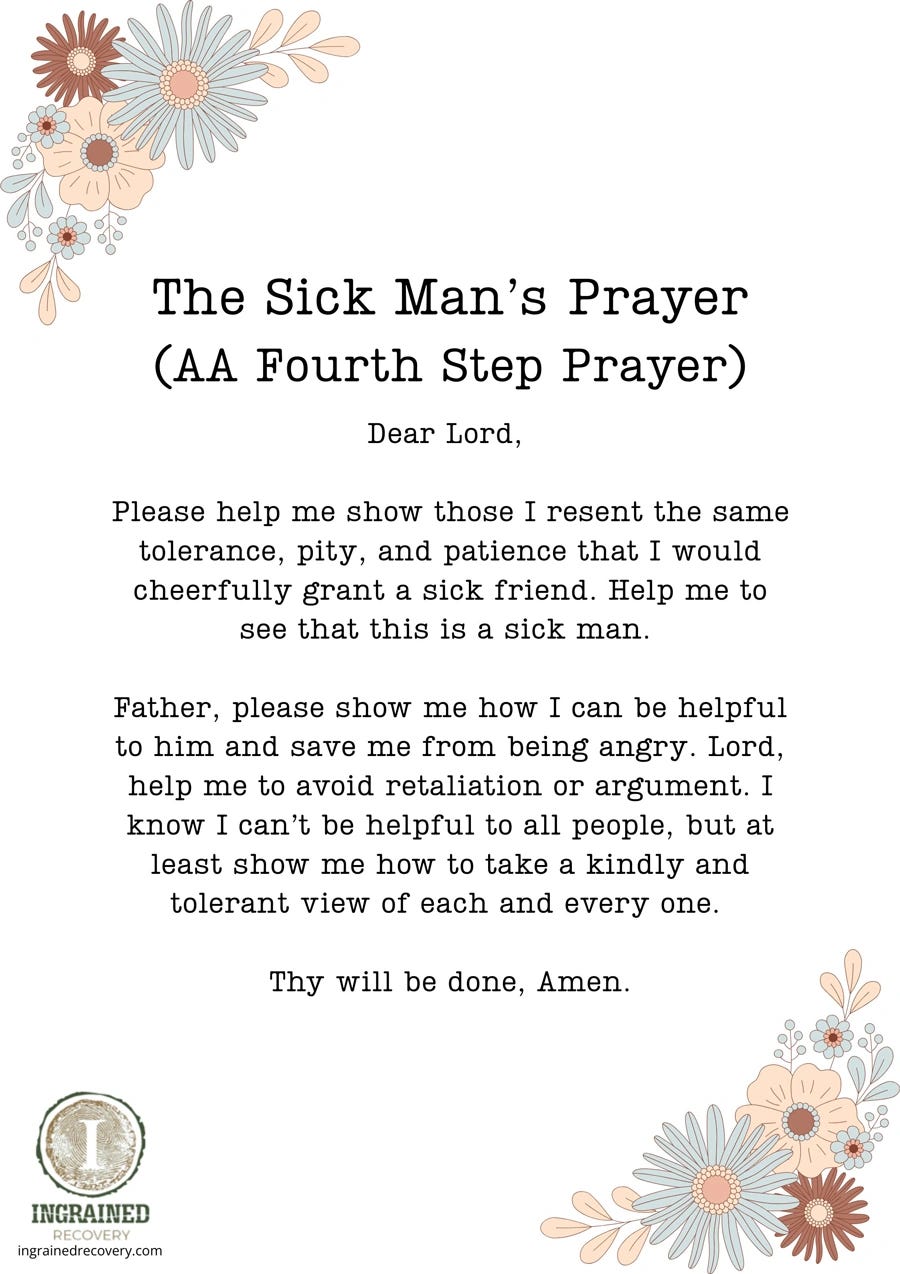
The Fourth Step prayer says:
“We asked God to help us show the same tolerance, pity, and patience that we would cheerfully grant a sick friend. When a person offended us, we said to ourselves: ‘This is a sick person. How can I help them? God save me from being angry. Thy will be done.’”
I heard someone say this the other day, and it really stuck out to me. When someone bothers us, can we say to ourselves: This is a sick person. Not an enemy. Not someone to resent. Just someone suffering.
Recently, after I left a very problematic relationship, one of my closest friends said to me: “I never saw you go into victim mentality once this whole time.”
And that meant everything to me. Because that is my practice. I don’t want to be in victim mentality anymore.
I don’t want to deny what he did, and I don’t want to excuse his harm. But I am choosing not to live in a harmful relationship. I am choosing to leave. And I’m choosing not to carry anger forward. If I can see someone as a sick person, then I don’t need to hold onto anger. And I don’t want to hold anger anymore.
I wrote about a lot of my past resentments and patterns in my book Sober Yoga Girl, which you can listen to here.
So why do I go to AA meetings? Someone asked me in early 2025 if I was going to meetings because I was struggling with my sobriety. No (at least not with alcohol sobriety).
I go to meetings because it is one of the few places where I consistently see people practicing, with sincerity, the teachings we speak about in yoga.
Not just talking about compassion.
Not just quoting philosophy.
But living it.
Upcoming Retreats & Trainings at Mindful Bali
June 14 - July 5, 2026 THREE SPOTS LEFT Book here
Alcohol-Free Women’s Retreats
August 18 – 23, 2026 THREE SPOTS LEFT Book here
Online Programs Coming Up:
Tuesdays 7:00am-9:00am Bali Time - ONLINE - The Buddha Dharma Philosophy Studies Sign up at this link (starts April 28 and runs for 10 weeks)


Love this! I’ve recently discovered (online cause there’s none near me) “secular AA” which focuses on different views than the traditional “white Christian male” that AA can sometimes center without realizing it. Like you said, the book was written for and by men. As much as people try to say it’s welcoming for all, sometimes women don’t feel that way the way. “A Women’s Way Through AA” is a good book that focuses on that as well, but is not technically “conference approved”.